

 Aug 15,2026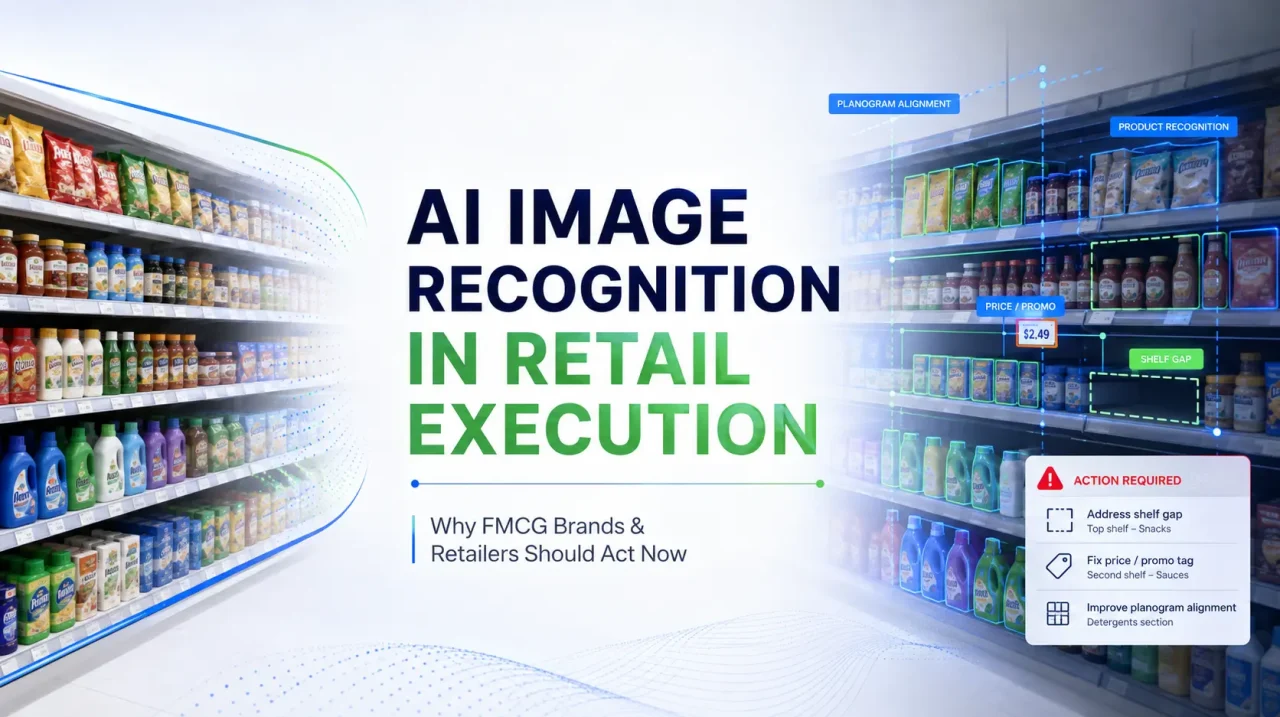
For years, retail execution teams have collected shelf photos as proof that a visit happened. The harder problem has always come afterwards: turning hundreds or thousands of images into consistent decisions before the next visit, promotion cycle, or management review.
AI Image Recognition in Retail Execution changes that workflow. Instead of treating a shelf photo as a static attachment, computer vision can help identify products, compare visible shelf conditions with an agreed standard, and highlight the exceptions that deserve attention.
For FMCG brand owners, that means a clearer view of how products are actually represented across stores. For retailers, it means a more structured way to verify pricing, promotions, availability, display standards, and store compliance. The reason to act now is not that every shelf decision should suddenly be handed to AI. It is that the foundations for AI-assisted execution—clean product references, structured photo capture, clear standards, and exception workflows—take time to build.
The real shift is simple: shelf photos are moving from proof of activity to a source of structured execution intelligence.
Why Retail Execution Is Reaching a Turning Point
Manual photo review can work when the operation is small. The model becomes harder to sustain when the number of outlets, SKUs, promotions, field users, and store images keeps increasing.
More Shelf Evidence
Store coverage and photo volume can grow faster than a supervisor’s ability to review every image manually.
Shorter Action Windows
Availability, pricing, and promotion issues lose value when they are discovered after the campaign or next replenishment cycle.
More Complex Standards
Different outlets may require different assortments, planograms, prices, promotions, and compliance rules.
The answer is not simply to collect more photos or ask managers to review faster. The execution process has to become more selective: capture the right evidence, analyse it consistently, flag important gaps, and direct people towards the action that follows.
What AI Image Recognition in Retail Execution Actually Means
AI image recognition in retail execution is the use of computer vision to analyse store and shelf images and convert visible conditions into structured information.
A typical workflow starts with a photo captured during a store visit. The system identifies products or visual elements, compares what it sees with reference data or business rules, and produces findings that can be reviewed by a field user, supervisor, retailer, or brand team.
This is different from using AI simply to label an image. Retail execution requires business context. A detected product becomes useful only when the system understands which store, category, planogram, campaign, or standard the image should be evaluated against.
Why FMCG Brand Owners Should Act Now
Brand owners invest heavily before a product reaches the shelf: product development, distribution, trade terms, category planning, promotions, packaging, and field execution. The final retail condition is where those decisions become visible to shoppers.
AI-assisted shelf analysis can help brand teams answer questions that are difficult to manage consistently through manual review alone:
- Are priority SKUs visible in the stores where they are expected?
- Is the agreed planogram being followed?
- Are promotional products and materials present during the campaign period?
- Is the brand gaining or losing visible shelf space against competitors?
- Which outlets repeatedly show the same execution gap?
The advantage is not merely faster image processing. It is the ability to compare execution across more stores using a more consistent method, then direct field attention towards the locations that need intervention.
Why Retailers Should Act Now
Retailers look at the same shelf from a different angle. Their concern is not only whether one brand has achieved its desired visibility, but whether stores are following agreed pricing, promotional, assortment, display, and compliance standards across categories.
For retailers, AI-assisted image analysis can support a more structured store-audit process. It can help surface stores that may require attention because of missing products, inconsistent displays, price or promotion issues, or other visible compliance gaps.
This is especially useful when a retailer operates many outlets with different store formats. Human audits remain important, but technology can help make the review process more consistent and make exceptions easier to prioritise.
Five Retail Execution Decisions AI Can Support
1. Is the Product Actually Available on the Shelf?
Warehouse stock does not automatically mean shopper availability. A product may exist somewhere in the supply chain while the retail shelf is empty. Shelf-image analysis can help identify visible gaps or expected products that do not appear in the captured shelf condition.
The next action still depends on the cause. The issue may require shelf replenishment, a stock check, a supply follow-up, or an account-level discussion.
2. Does the Shelf Match the Intended Planogram?
Planogram compliance is difficult to review consistently when supervisors inspect images manually across large numbers of outlets. Image recognition can compare the visible shelf with an approved reference and highlight missing, misplaced, or unexpected products.
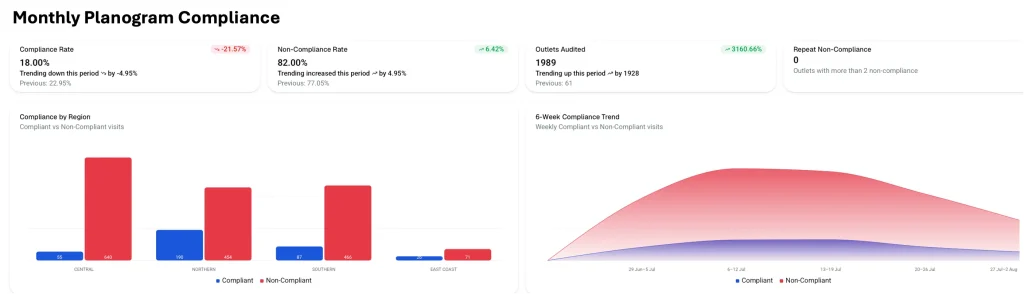
A flagged difference is the start of a decision, not the end. Store format, shelf constraints, temporary displays, and retailer-approved exceptions still need to be considered.
3. Are Price and Promotion Standards Being Executed?
Promotions often involve more than having the product in stock. The visible price, promotional label, display material, product position, and campaign timing may all matter. AI-supported review can help teams identify images that appear inconsistent with the expected promotion or price setup.
4. What Is Happening to Share of Shelf and Competitor Presence?
Shelf images can also support measurements of visible product facings and competitor presence. For a brand owner, this helps make shelf-position discussions more evidence-based. For a retailer, it can help show whether category and display standards are being maintained consistently.
5. Which Stores Require a Compliance Follow-Up?
When image findings are combined with structured audit tasks, managers can move from reviewing every store equally to prioritising stores with specific execution gaps. That makes the audit process more useful because the output is connected to ownership and corrective action.
Manual Review vs AI-Assisted Retail Execution
| Execution Task | Manual-Only Approach | AI-Assisted Approach |
|---|---|---|
| Shelf photo review | Supervisor opens and interprets images individually | Images can be screened for specific products and execution conditions before review |
| Planogram checks | Reviewer compares each image with a reference manually | Visual differences can be flagged against an approved reference |
| Availability review | Field notes and photos are checked one store at a time | Potential shelf gaps can be surfaced for prioritised follow-up |
| Share of shelf | Facings or visible space are counted manually | Detected products and facings can support structured measurement |
| Management attention | Review effort is spread across most submissions | Teams can focus more attention on exceptions and uncertain cases |
The strongest operating model is usually not “manual or AI.” It is manual judgement supported by automated analysis. AI handles repeatable visual checks; people handle context, uncertainty, retailer relationships, physical shelf correction, and commercial decisions.
What AI Should Not Be Asked to Solve Alone
AI image recognition can improve visibility, but it does not remove the operational work required after a problem is found.
- It cannot physically replenish an empty shelf.
- It cannot move products when store staff or retailer approval is required.
- It cannot decide that every planogram difference is wrong without understanding store-specific exceptions.
- It still depends on usable shelf photos, current product references, and accurate execution standards.
- It should not replace human review for commercially important or uncertain cases.
Detection is not correction. The commercial value comes from how quickly the organisation turns a detected execution gap into an owned next action.
What FMCG Brands and Retailers Should Do Now
Acting now does not require an immediate chain-wide AI rollout. A more practical first move is to prepare the execution system so AI can be tested against real operating conditions.
- Choose one high-value execution problem. Start with planogram compliance, availability, promotion verification, share of shelf, or store-audit evidence rather than trying to automate every visual check.
- Clean the product references. Current product images, packaging variations, SKU information, and category references are essential inputs for reliable analysis.
- Standardise photo capture. Define the required angle, distance, shelf area, and evidence for the chosen use case.
- Define the expected standard. Make sure the planogram, price, promotion rule, assortment, or audit requirement being used for comparison is current and store-appropriate.
- Decide who owns each exception. A shelf gap, promotion problem, pricing issue, or compliance failure may require different follow-up teams.
- Pilot with real stores. Include normal shelves and difficult conditions such as new packaging, partial occlusion, mixed displays, poor lighting, and retailer-approved exceptions.
A useful pilot should answer two questions: can the system identify the execution conditions that matter to your business, and can your organisation act on those findings faster than it does today?
How Interact Supports AI-Assisted Retail Execution
Interact combines field merchandising workflows with AI-supported shelf analysis. Its Field Merchandising solution supports structured visit planning, on-shelf availability and planogram photos, price checks, stock takes, promotion compliance, share-of-shelf monitoring, and merchandising dashboards.
Interact’s AI-Powered Field Execution capabilities analyse shelf photos for planogram compliance, possible out-of-stock conditions, price and promotion verification, competitor presence, share-of-shelf measurement, and other execution gaps.
For more formal store checks, the Store Compliance Audits solution supports structured audit tasks, compliance checks, photo evidence, issue reporting, and store-level execution review.
The earlier guide on how to improve merchandising execution explains the wider operating process around standards, store visits, exceptions, and corrective action. AI image recognition fits into that process as a way to make visual evidence more structured and easier to act on.
The Cost of Waiting Is Mostly Organisational
The strongest reason to start now is not fear of missing a technology trend. It is that useful AI depends on operational preparation.
Brands and retailers that begin standardising product references, photo capture, store rules, exception ownership, and baseline measurements today will be in a better position to test AI against real business problems. Teams that postpone those foundations may eventually buy better technology but still struggle to turn its outputs into action.
AI image recognition should therefore be treated as part of retail execution design, not as a standalone image-processing project. The objective is not to recognise more products for the sake of recognition. The objective is to see execution gaps earlier, understand them more consistently, and act while the store condition can still be improved.
Frequently Asked Questions
AI image recognition in retail execution uses computer vision to analyse shelf or store photos and convert visible conditions into structured findings such as product presence, planogram differences, possible availability gaps, pricing or promotion issues, and competitor presence.
A manual audit relies on people to inspect and interpret each store condition. AI shelf recognition can automate repeatable visual checks and flag exceptions, while people remain responsible for context, uncertain cases, physical corrections, and commercial decisions.
Yes, when the system is configured with suitable product references, shelf images, and execution standards, image recognition can help identify possible shelf gaps and planogram differences for review and follow-up.
Yes. AI can reduce repetitive visual review, but people are still needed to capture usable evidence, verify uncertain findings, correct shelves, work with store staff, manage exceptions, and make commercial decisions.
Turn Shelf Photos into Actionable Execution Intelligence
See how Interact can analyse your own shelf images, surface execution gaps, and connect visual evidence to a more structured merchandising and store-audit workflow.
Book a Personalised Demo