



 Aug 09,2026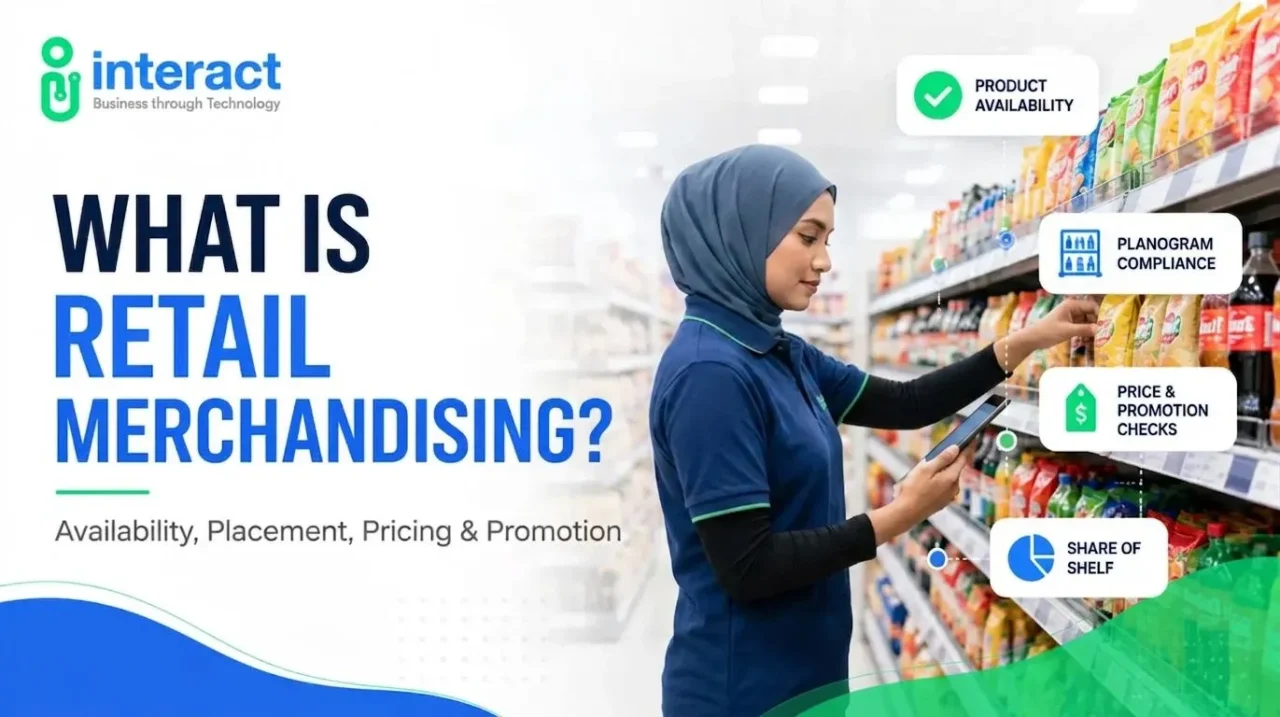
A brand can secure distribution, negotiate a promotion, and deliver stock to a retailer—yet still lose the sale at the final metre. The product may be missing from the shelf, placed in the wrong position, shown with an outdated price, or hidden behind competing products.
That final metre is where retail merchandising matters. It turns commercial plans into visible, measurable execution inside the store.
So, what is retail merchandising? It is the organised process of making sure the right products are available, correctly arranged, accurately priced, and supported by the required promotions at the point of sale. For FMCG and consumer brands, it connects sales agreements, supply availability, brand standards, and the shelf experience shoppers actually see.
1. The Retail Reality: Shoppers Buy What They Can See
Retail execution can break even when the earlier parts of the business appear healthy. A warehouse may show stock, while the store shelf is empty. A promotion may be approved, while the display material is missing. A planogram may exist, while the actual product sequence is different.
Managers therefore need answers to practical questions:
- Is the expected product visible on the shelf?
- Is it placed in the agreed position?
- Does the displayed price match the current activity?
- Are promotional materials installed correctly?
- How much shelf space does the brand occupy?
- Which stores require corrective follow-up?
2. What Retail Merchandising Actually Covers
Retail merchandising covers the field activities used to manage product presence inside physical retail outlets. It is broader than arranging attractive displays. It includes availability, placement, pricing, promotion, compliance, evidence, and follow-up.
The work may be completed by dedicated merchandisers, promoters, supervisors, sales representatives, retail employees, or third-party agencies. The responsibilities vary by product category and retailer, but the objective remains consistent: make the agreed retail standard visible at store level.
Retail merchandising is the operating discipline behind shelf execution. It checks whether the product, price, placement, and promotion agreed by the business are present where the shopper makes the decision.
3. Retail Merchandising, Sales, and Visual Merchandising Are Different
These functions overlap, but they should not be treated as the same job.
| Function | Main Focus | Typical Evidence |
|---|---|---|
| Retail sales | Winning orders, accounts, listings, and commercial agreements | Orders, invoices, account activity, revenue |
| Retail merchandising | Executing availability, placement, price, promotion, and store standards | Visit records, stock counts, shelf photos, audit results |
| Visual merchandising | Creating an attractive and coherent visual presentation | Window displays, store layouts, display concepts, brand presentation |
A salesperson may secure a listing and promotional agreement. A retail merchandiser checks whether the product arrived, reached the shelf, received the agreed space, displayed the correct price, and followed the campaign requirements. A visual merchandiser may then focus more deeply on how the display looks and supports the overall store experience.
4. The Six Core Activities of Retail Merchandising
On-Shelf Presence
Check whether expected SKUs are visible and record possible shelf gaps or low-stock conditions.
Planogram Compliance
Compare product position, sequence, shelf level, and facings with the approved arrangement.
Price and Promotion
Verify displayed prices, campaign labels, promotional materials, and promoted-product availability.
Share of Shelf
Measure the visible shelf space or facings occupied by a brand using a clearly defined method.
Competitor Visibility
Record competitor products, displays, prices, promotions, and possible intrusion into agreed positions.
Store Audits
Complete structured checks, attach photo evidence, identify issues, and confirm required standards.
5. What Happens During a Merchandiser Store Visit?
A good visit gives the merchandiser a clear purpose. The user should know which store to visit, which products or displays to inspect, what evidence to capture, and which problems can be corrected immediately.
- Review the assignment. Check the outlet, tasks, products, campaign, and expected standard.
- Inspect the shelf. Review availability, placement, facings, prices, promotions, and expiry information where relevant.
- Correct what is permitted. Replenish or rearrange products, replace materials, or coordinate with store staff.
- Capture evidence. Record counts, checklist answers, shelf photos, and before-and-after conditions.
- Escalate exceptions. Send unresolved stock, pricing, listing, or compliance issues to the responsible team.
- Close the visit. Submit the completed record so supervisors can review results and trends.
The visit should produce more than a collection of photos. Each record should be connected to the correct store, product, task, date, user, and required follow-up.
6. Why Manual Merchandising Reporting Does Not Scale
Sending shelf photos through messaging apps can appear convenient, but the method becomes difficult to control across many outlets and users.
- Photos become separated from the store, product, visit, and required task.
- Supervisors must open and interpret images one by one.
- Different users may apply different definitions of compliance.
- Availability and promotion issues may be discovered too late.
- Comparing outlets, regions, teams, or campaigns becomes difficult.
- Corrective actions are easily lost after the original message.
The problem is not a lack of evidence. It is a lack of structured, searchable evidence connected to action.
7. How Field Merchandising Software Improves the Process
Field merchandising software gives teams a consistent mobile workflow for visits, tasks, checklists, counts, photos, issues, and reporting.
Instead of receiving an isolated shelf image, the manager receives a structured record showing where it was captured, which task it supports, which products were checked, what result was recorded, and whether follow-up is required.
A practical system may support:
- Visit planning and task assignment
- Product availability and stock counts
- Planogram and shelf-photo capture
- Price, promotion, and product-age checks
- Structured store-compliance audits
- Outlet, team, and campaign dashboards
- Issue assignment and corrective follow-up
Software does not define the business standard by itself. The company still needs accurate outlet assignments, current planograms, product references, promotion rules, and clear responsibilities.
8. How AI Image Recognition Supports Retail Merchandising
AI image recognition can analyse shelf photos and help convert visible store conditions into structured information.
Depending on the product references, photo quality, business rules, and system configuration, it may support:
- Product or SKU detection
- Visible-facing counts
- Possible shelf-gap or out-of-stock flags
- Planogram comparison
- Share-of-shelf measurement
- Price-tag and promotional-material checks
- Competitor-presence monitoring
AI can help supervisors focus on exceptions rather than manually checking every image. It cannot physically replenish a shelf, move a misplaced product, replace a label, or resolve a discussion with the retailer. Human action remains part of the process.
Use AI as operational intelligence, not unquestionable proof. Unclear photos, packaging changes, blocked products, incorrect planograms, and outlet-specific exceptions can all affect how a result should be reviewed.
9. How Interact Supports Field Merchandising and Retail Execution
Interact’s Field Merchandising solution provides a mobile-first workflow for planning store visits, assigning tasks, capturing shelf conditions, checking product availability, recording stock counts, validating prices, tracking product ageing, monitoring promotions, and reviewing share of shelf.
Field teams can complete merchandising work using standard smartphones. Submitted photos and stock records can be linked to a specific store, product, date, and quantity, making the evidence easier to search, compare, and report than unstructured messaging threads.
Interact’s AI Execution Intelligence supports shelf-photo analysis for planogram compliance, possible out-of-stock conditions, price and promotion verification, share-of-shelf measurement, competitor presence, and execution-gap identification.
For formal standards, Interact’s Store Compliance Audits solution supports task-based audits, configurable checks, photo evidence, compliance reporting, recurring-issue visibility, and corrective follow-up.
The final scope should be confirmed using the company’s own store formats, products, planograms, promotions, and audit requirements.
10. Where to Start
A merchandising improvement programme works best when it begins with a narrow, measurable problem rather than every store and every SKU at once.
- Choose one priority. Start with availability, planogram compliance, promotion execution, or store-audit consistency.
- Select a representative pilot. Use a manageable group of outlets, users, and products that reflects normal operating conditions.
- Define the standard. Confirm the required assortment, planogram, prices, promotion materials, evidence, and escalation rules.
- Measure action, not only data collection. Track whether identified issues are corrected and whether recurring problems become easier to see.
The purpose of retail merchandising is not to generate more reports. It is to make shelf execution clearer, more consistent, and easier to improve.
Frequently Asked Questions
Retail merchandising is the work of making sure products are available, correctly arranged, accurately priced, and supported by the required promotions inside a retail store.
Retail merchandising covers availability, placement, stock, pricing, promotion, and compliance. Visual merchandising focuses more specifically on the appearance and presentation of displays and the store environment.
A field merchandiser may check product availability, shelf position, facings, prices, promotions, expiry information, stock quantities, competitor activity, and other assigned store standards.
No. AI can help analyse images and identify possible execution gaps, but people are still needed to correct displays, replenish products, communicate with store staff, verify uncertain results, and complete follow-up actions.
See Your Shelf Execution More Clearly
Use your own outlet workflow, products, planograms, and store requirements to see how Interact can structure merchandising visits, shelf evidence, AI-supported analysis, and corrective follow-up.
Book a Personalised Demo